2025

Nerry Berman… a memoir made public

The memoir I’ll Go On Living, the result of many years of reflection and work by my mother, Nerry Berman, has been made public. The book was edited by Nerry Berman’s direct descendants: Benjamin Antonetti, great-grandson; Elena Antonetti, granddaughter; Mark Berman, son; Rina Berman, daughter.

Spanning the Russian Empire, the USSR, World Wars I and II, and the postwar years, it traces five generations of two Jewish families in Ukraine and Russia. She recounts the life paths that connected her with Joseph Berman, a young soldier worn down by four years on the Eastern Front. More than a personal memoir, the work reflects Nerry’s lifelong and genuine interest in gathering and preserving fragments of family lives; the family tree behind the narrative brings together over 200 individuals across generations. Rooted in personal experience, the narrative also stands as a historical record of survival, resistance, and the choice to go on living.

The memoir is available on Amazon in hardcover. A free downloadable PDF edition (125 MB) is also available.

Copyright © 2025 by the Estate of Nerry Berman

Language ‏ : ‎ English

Print length ‏ : ‎ 251 pages

Illustrations: Photographs from the family archives

ISBN: 979-8-293-22213-1

autumn at core creek…geese, deer, and a chance of humans...lake luxembourg

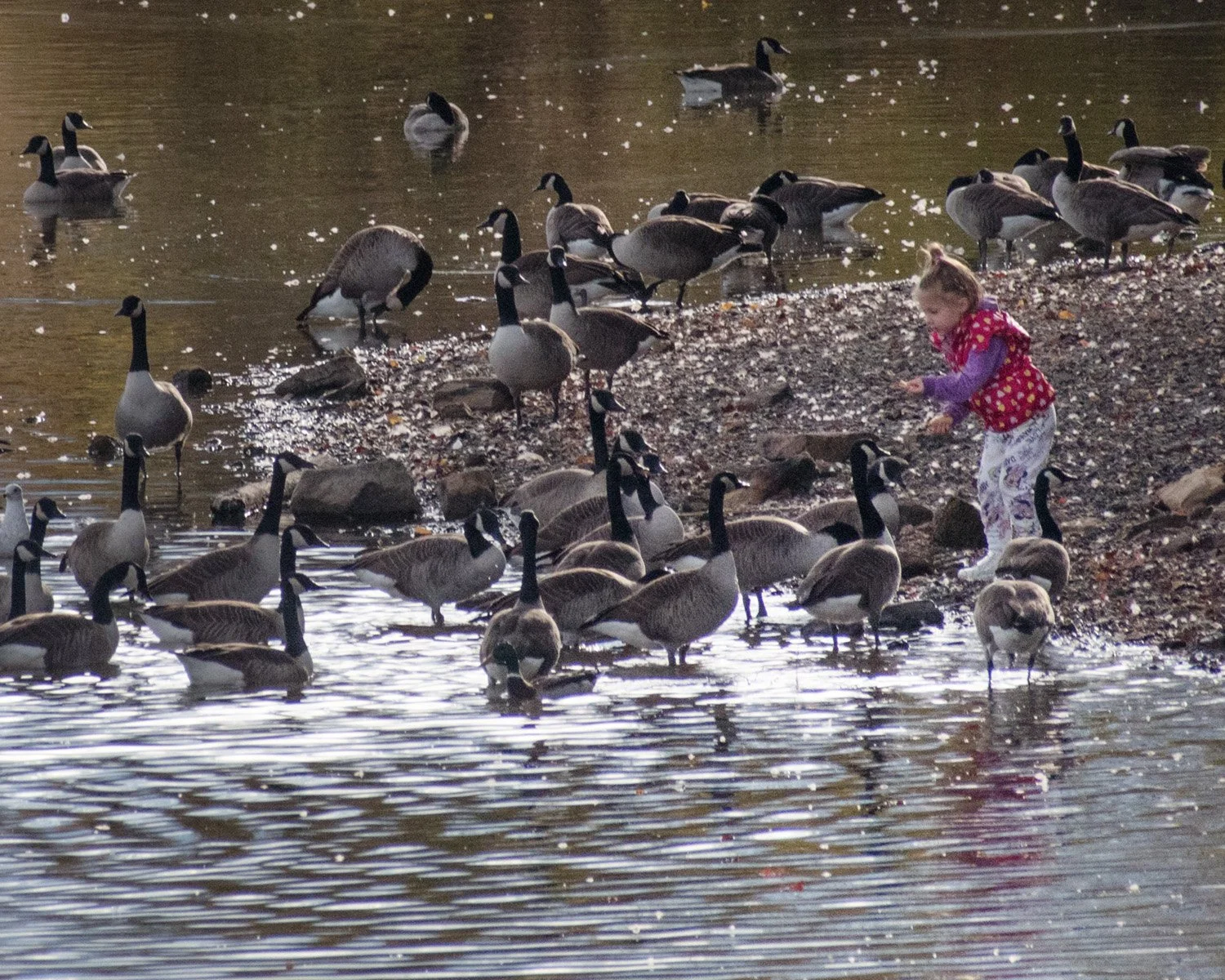
The thousands of geese are filling three of Nature’s elements this time of year: the Air, the Waters of Lake Luxembourg, and the Earth of the surrounding fields. The deer, thankfully, stick to the fields only. The weekend crowds of humans have faded; now I just sightsee the odd one here and there.

It’s the best stretch of the year: colorful, calm, pleasant, and quiet. Great light, great air, and nobody bothering anybody.

The views are so good it’s almost unfair. Choosing which photos to share was the real challenge. Your screens won’t show every tiny detail in the images, so I added a few close-up crops to give you a sense of what you’re missing.

Close-up crop of a tiny middle section of the panorama above

Close-up crop of a middle section of the image above

joyful day revisited...Simchat Torah 2009

The year is 2009. Lucy and I joined our daughter’s family for Simchat Torah at Congregation Beth Israel of West Hartford, CT. It was a beautiful celebration, full of genuine warmth. Rabbi Stephen Fuchs led the ceremony, and I walked around with my camera capturing as much of it as I could. I took a lot of photographs that day. One picture I kept coming back to became my favorite, and I printed several copies, among them one for Rabbi Fuchs and another for the Temple. Then life moved on, and for some reason I never published the images or even looked at them again.

Not long ago, I received a very kind message from Rabbi Fuchs telling me how much he and his wife still treasure that photograph. Hearing that encouraged me to revisit those old files. So I dusted off the archive and decided it was time to finally share the joy of that day.

Here are a few images from the 2009 celebration.

Here it is, the photo that became my favorite:

from beast to maiden...clearing Medusa's name


Clarification Note: The text of this post was prepared using ChatGPT and Claude AI . The images in the post were crafted by Midjourney AI that followed my prompts.


In Greek mythology, the Titans were ancient deities who ruled in peace and harmony before the Olympian gods. After the Titans lost to the Olympians, long before the time of Ancient Greece, the Titans' images were demonized. This demonization later became embedded in the myths of Ancient Greece and was eventually passed down to Western culture as it was. Medusa, the most beautiful maiden of Titan origin, did not escape this fate. Today, her name is commonly associated with a terrifying monster whose murder was considered a blessing. To restore justice let us explore the original version of Medusa's myth.

Various versions of the restored myth of Medusa have been proposed. I lean towards the one inspired by Golosovker's "Tales of the Titans" and the lectures from the Forgotten Ruins channel, particularly the lecture "The Gorgon Medusa - The End of the Legend." I highly recommend both sources to readers interested in exploring the subject further. Neither of them is available in English, but they can be easily translated using modern AI tools. The next best option for English-speaking readers is the excellent novel by William Tenn, “Medusa Was a Lady” (click the link to read it).

So, let's begin our journey from Beast to Maiden.

Medusa: Beauty Behind the Myth

Digest to ‘The Tale of the Titaness Gorgon Medusa'

Children of Gaia (Earth) and Uranus (Sky) — the Titans Phorcys and Ceto — had six daughters (The Phorcydes). Three of them — Pemphredo, Enyo, and Dino — were called the Graeae and were known for their silver hair and beauty. The other three — Stheno, Euryale, and Medusa — were the beautiful Gorgons with golden wings.

( Undoubtedly, the names "Graeae"-"Old Women" and "Gorgon"-"Terrifying" were given to the Phorcydes by the Olympian gods following the Phorcydes defeat. This was done to erase any memory of their once-beautiful nature.)

After the fall of the Titans and the rise of the Olympian gods, the Phorcydes refused to bow to the new rulers. Athena-Pallas, daughter of Zeus and the Titan Metis, envied Medusa's beauty and strength, especially her hair. Poseidon, urged on by Athena, chased Medusa and eventually raped her in a temple where she was hiding. Not satisfied with this, Athena, in her anger, transformed Medusa from a beautiful girl into a monstrous figure with snake hair and a gaze that turned everything to stone.

(By the way, the story of Athena's nickname, Pallas, perfectly illustrates her wild sadistic nature. After she defeated the Giant Pallas, Athena skinned him alive to make her breastplate. She also added the Giant's name to her own as a trophy, which is why she's often referred to as “Pallas” or “Pallas Athena.” She later affixed the head of the Gorgon Medusa to it. The other version is that the breastplate was made from the hide of her "milk grandmother", the goat Amalthea, who nursed her father Zeus as an infant. It's up to you to decide which version sounds less shocking.)

Medusa became an outcast and had to hide with her sisters at the edge of the world, guarded by the Graeae. Once a year, the Gorgons would fly out into the world, and during that time Medusa realized her gaze could turn anything to stone.

Athena inspired Perseus, the son of Danaë and Zeus, to want to cut off Medusa's head, and Hermes helped him find the way. Perseus got magical items from the nymphs: a bag, an adamantine sickle, and Hades' cap of invisibility. Athena also gave Perseus a mirror-like shield so he could see Medusa without looking directly at her.

Using trickery, Perseus forced the Graeae to show him the way to the Gorgons. When he arrived, he cut off Medusa's head. From Medusa's body came the winged horse Pegasus and the titan Chrysaor. Medusa's sisters woke up and tried to chase Perseus, but they couldn't catch him. By the gods' command, Perseus returned all the magical items, including Medusa's head, which Athena placed on her breastplate.

Athena also collected Medusa's blood, which could either save or kill people, and gave it to the healer Asclepius. Asclepius used it to bring the dead back to life, breaking the law of Ananke, the inevitability of fate. This disruption of the natural order of the cosmos angered Zeus and he struck Asclepius down with a lightning bolt to remind everyone of the inevitability of death.

My drawing of Perseus from around 1954, which I found many years later in my mom’s archive

Homage to Medusa

Since many people will see the images on small screens, which might not highlight the images' nuances, here are some enlarged fragments of "Homage to Medusa" to enhance the viewers' experience.

Medusa's Cenotaph

Mourning Giantess

core creek park and lake...50 shades of green

After multiple rains, Core Creek Park is showing off. The leaves look freshly rinsed - more spring than summer. Shades of green are everywhere. Every path is lined with color - soft, deep, vibrant, layered, and alive.

The regulars are back: dog walkers, geese, deers - everyone enjoying the calm.

mjb and mj...ch8. Alfons Mucha goes mobile


Clarification Note: The images in the post was crafted in cooperation with Midjourney AI, which followed my prompts.


I love the elegance of Alfons Mucha’s work — the flowing lines, ornate details, and those timeless muses that seem to float right off the canvas. Lately, I found myself browsing through that style with a small postmodern, anachronistic twist — just a hint of absurdity.

Usually, when artists play with anachronism, they go for the classic mix: characters from the past wearing slightly-too-modern outfits — like medieval Hamlet characters dressed for the Renaissance — but still carrying props like swords to anchor the scene in its intended era.

So I thought… what if we flipped that around?

What if we kept all the vintage charm — those gorgeous Victorian gowns, the elegant floral frames — but dropped in a bit of 21st-century tech? You know, earbuds to complement the earrings. iPhones instead of lace fans. A muse checking her messages instead of admiring her reflection.

With that idea in mind, I let AI run wild and generate a batch of Mucha-inspired “paintings.” From dozens of results, I’ve picked a few favorites to share the joy (and the gentle absurdity) with you.

Here’s my top pick from the batch:

And a few more for good measure.

Enjoy the scroll — no strolling required.

lost in time...winter on newtown’s last farm

We settled in Newtown Township in 1996, right on the edge of Newtown Borough - a small town of about 2,000 people. Back then, our backyard overlooked farmland, with open fields stretching in all directions.

Fast forward to the 2020s, and the landscape has completely transformed. The farms that once surrounded us have disappeared, replaced by single-family homes, condominiums, and shopping centers. Though the area still retains its suburban charm with plenty of green spaces and parks, the only farm that remains nearby is Shady Brook Farm.

Shady Brook Farm, in particular, has seen rapid development around it. With condominiums and commercial buildings now encroaching on its borders, its future feels uncertain. Sadly, these might be its final years. A landscape once timeless, now fading into memory.

I drive by its fields daily, taking in the ever-changing scenery - vast open spaces, an unobstructed sky filled with dramatic or cheerful clouds, and the shifting colors of the seasons. This winter has been unusually warm, with little snow. Here’s a glimpse of how it looks nowadays - starting with bare fields,

then a light dusting of snow as the snowfall begins to accumulate,

and finally, a snow-covered field

lake luxembourg...shinrin-yoku

Lake Luxembourg is my go-to spot for practicing shinrin-yoku - or forest bathing. This Japanese relaxation practice is all about slowing down, being calm among the trees, and soaking in the beauty of nature. It’s as simple as using your senses to observe the little details around you.

When I’m there, I sit or walk quietly with a camera, staying mindful of my surroundings. The trick is to leave daily worries behind and focus on the moment—like watching forest creatures go about their day.

Nature’s colors and sounds are incredibly soothing. While some people find green and blue the most relaxing, my favorite palette leans toward muted yellows, earthy browns and reds. On my last visit, the scene was perfect: withered grass glades, bare trees, and a frozen lake under the soft light of a cloudy winter sky.

There wasn’t any snow, and the place was completely deserted - except for a lone gray heron. These birds are usually pretty shy, but the frozen lake and quiet surroundings seemed to make it feel at ease, standing out in the open.

It was a peaceful moment, just me and the heron, soaking up the tranquility of the season.