Artificial Intelligence

from beast to maiden...clearing Medusa's name


Clarification Note: The text of this post was prepared using ChatGPT and Claude AI . The images in the post were crafted by Midjourney AI that followed my prompts.


In Greek mythology, the Titans were ancient deities who ruled in peace and harmony before the Olympian gods. After the Titans lost to the Olympians, long before the time of Ancient Greece, the Titans' images were demonized. This demonization later became embedded in the myths of Ancient Greece and was eventually passed down to Western culture as it was. Medusa, the most beautiful maiden of Titan origin, did not escape this fate. Today, her name is commonly associated with a terrifying monster whose murder was considered a blessing. To restore justice let us explore the original version of Medusa's myth.

Various versions of the restored myth of Medusa have been proposed. I lean towards the one inspired by Golosovker's "Tales of the Titans" and the lectures from the Forgotten Ruins channel, particularly the lecture "The Gorgon Medusa - The End of the Legend." I highly recommend both sources to readers interested in exploring the subject further. Neither of them is available in English, but they can be easily translated using modern AI tools. The next best option for English-speaking readers is the excellent novel by William Tenn, “Medusa Was a Lady” (click the link to read it).

So, let's begin our journey from Beast to Maiden.

Medusa: Beauty Behind the Myth

Digest to ‘The Tale of the Titaness Gorgon Medusa'

Children of Gaia (Earth) and Uranus (Sky) — the Titans Phorcys and Ceto — had six daughters (The Phorcydes). Three of them — Pemphredo, Enyo, and Dino — were called the Graeae and were known for their silver hair and beauty. The other three — Stheno, Euryale, and Medusa — were the beautiful Gorgons with golden wings.

( Undoubtedly, the names "Graeae"-"Old Women" and "Gorgon"-"Terrifying" were given to the Phorcydes by the Olympian gods following the Phorcydes defeat. This was done to erase any memory of their once-beautiful nature.)

After the fall of the Titans and the rise of the Olympian gods, the Phorcydes refused to bow to the new rulers. Athena-Pallas, daughter of Zeus and the Titan Metis, envied Medusa's beauty and strength, especially her hair. Poseidon, urged on by Athena, chased Medusa and eventually raped her in a temple where she was hiding. Not satisfied with this, Athena, in her anger, transformed Medusa from a beautiful girl into a monstrous figure with snake hair and a gaze that turned everything to stone.

(By the way, the story of Athena's nickname, Pallas, perfectly illustrates her wild sadistic nature. After she defeated the Giant Pallas, Athena skinned him alive to make her breastplate. She also added the Giant's name to her own as a trophy, which is why she's often referred to as “Pallas” or “Pallas Athena.” She later affixed the head of the Gorgon Medusa to it. The other version is that the breastplate was made from the hide of her "milk grandmother", the goat Amalthea, who nursed her father Zeus as an infant. It's up to you to decide which version sounds less shocking.)

Medusa became an outcast and had to hide with her sisters at the edge of the world, guarded by the Graeae. Once a year, the Gorgons would fly out into the world, and during that time Medusa realized her gaze could turn anything to stone.

Athena inspired Perseus, the son of Danaë and Zeus, to want to cut off Medusa's head, and Hermes helped him find the way. Perseus got magical items from the nymphs: a bag, an adamantine sickle, and Hades' cap of invisibility. Athena also gave Perseus a mirror-like shield so he could see Medusa without looking directly at her.

Using trickery, Perseus forced the Graeae to show him the way to the Gorgons. When he arrived, he cut off Medusa's head. From Medusa's body came the winged horse Pegasus and the titan Chrysaor. Medusa's sisters woke up and tried to chase Perseus, but they couldn't catch him. By the gods' command, Perseus returned all the magical items, including Medusa's head, which Athena placed on her breastplate.

Athena also collected Medusa's blood, which could either save or kill people, and gave it to the healer Asclepius. Asclepius used it to bring the dead back to life, breaking the law of Ananke, the inevitability of fate. This disruption of the natural order of the cosmos angered Zeus and he struck Asclepius down with a lightning bolt to remind everyone of the inevitability of death.

My drawing of Perseus from around 1954, which I found many years later in my mom’s archive

Homage to Medusa

Since many people will see the images on small screens, which might not highlight the images' nuances, here are some enlarged fragments of "Homage to Medusa" to enhance the viewers' experience.

Medusa's Cenotaph

Mourning Giantess

mjb and mj...ch8. Alfons Mucha goes mobile


Clarification Note: The images in the post was crafted in cooperation with Midjourney AI, which followed my prompts.


I love the elegance of Alfons Mucha’s work — the flowing lines, ornate details, and those timeless muses that seem to float right off the canvas. Lately, I found myself browsing through that style with a small postmodern, anachronistic twist — just a hint of absurdity.

Usually, when artists play with anachronism, they go for the classic mix: characters from the past wearing slightly-too-modern outfits — like medieval Hamlet characters dressed for the Renaissance — but still carrying props like swords to anchor the scene in its intended era.

So I thought… what if we flipped that around?

What if we kept all the vintage charm — those gorgeous Victorian gowns, the elegant floral frames — but dropped in a bit of 21st-century tech? You know, earbuds to complement the earrings. iPhones instead of lace fans. A muse checking her messages instead of admiring her reflection.

With that idea in mind, I let AI run wild and generate a batch of Mucha-inspired “paintings.” From dozens of results, I’ve picked a few favorites to share the joy (and the gentle absurdity) with you.

Here’s my top pick from the batch:

And a few more for good measure.

Enjoy the scroll — no strolling required.

they are coming...brushed in tradition, framed in code...atelier Nexus


Clarification Note: The images in the post was crafted in cooperation with Midjourney AI, which followed my prompts


It’s already a reality.

AI-powered robots are reshaping the art world. On November 7, a 7.5-foot portrait of Alan Turing created by Ai-Da, the world’s first ultra-realistic robot artist, sold for $1,084,800 at Sotheby’s Digital Art Sale, far surpassing the pre-sale estimate of $180,000.

I am not sure if AI artist studios will proliferate in the future as photography studios did during the boom of the early 20th century. Still, the idea of breathing new life into classic image-making in the Silicon Age is intriguing.

What if traditional artistry and cutting-edge technology came together in a harmonious blend? In that spirit, here’s a glimpse into the imagined AI art studio 'Atelier Nexus,' a place where timeless techniques and futuristic innovation coexist.

hey pumpkins..happy halloween


Clarification Note: The image in the post was crafted in cooperation with Midjourney AI, which followed my prompts.


A brave new world - a post-AI Halloween celebration. A dead serious chill - the day of the living.


Postscript:

To my surprise, not everyone got the humor of this post. So here’s an explanation by ChatGPT:

'The humor here comes from flipping Halloween traditions and adding a futuristic twist. Halloween usually celebrates the "Day of the Dead," but in this "post-AI" world, skeletons are now the ones chilling out and watching humans, dressed as dolls like Barbie and Ken, put on a show. This “day of the living” implies that the roles have been reversed—it's the undead who are now relaxed spectators of humanity, which is cleverly ironic.

Also, "A dead serious chill" plays with the double meaning of "dead" and "chill," implying both relaxation and a spooky vibe, fitting for a Halloween scene.'

mjb and mj...ch6. 2024...box that is always with you


Clarification Note: All images in the post were crafted in cooperation with Midjourney AI, which followed my prompts.


Quick Summary for Those Who Prefer a Short Read:

2024. Things are going wrong, and we’re unsure how to fix them. ‘Thinking outside the box’ sounds good, but it usually just creates another box. Using intuition and non-logical thinking might help, but it’s hard to convey the results to others because words often fall short. We’re at a confusing crossroads, and here’s my visual take on this less-than-optimistic observation


'Suppose you succeed in breaking the wall with your head.

And what, then, will you do in the next cell?'

 Stanislaw Jerzy Lec

2024. Everything is going in the wrong direction and nobody knows what to do with it.

We need leaders who can think outside the box, just like the heroes in all those great books and movies. ‘Thinking outside the box’ sounds like a great idea. It should save the world, right?

But the more I thought about it, the more I realized that stepping outside one box just puts us into another box. Here's why:

If we define ‘thinking’ as the mental process that involves language and logic, then those things create a sort of ‘box’ for our thoughts. So, ‘thinking outside the box’ means going beyond the usual ideas we know, but it’s still just thinking within another set of ideas, or another box.

What about ‘thinking outside A box’? That means thinking beyond any set of established ideas, not just swapping one set for another. But here's the tricky part: as soon as we start thinking, we create structures or ‘boxes’ to organize our thoughts. So, the idea of thinking completely outside any box is kind of impossible because even trying to do that makes a new box. It leads nowhere.

Well, there is a way out of the ‘thinking box’ trap that’s not very popular in our science-focused world: tapping into intuition and other non-logical ways of knowing. While we usually think of logical thinking as the best kind, this overlooks other ways of understanding the world. Intuition, for example, lets us process information quickly and often subconsciously, leading to insights that logic might miss. Non-verbal thinking, like visual or spatial reasoning, also plays a big part in solving problems and being creative.

But here's the catch: communicating these intuitive and non-verbal insights is tough. They don’t follow the clear, structured paths of logical reasoning. When we try to explain these insights, we have to put them into words, which can be limiting and might not capture the full essence of our understanding.

So, we have a paradox: while intuition and non-verbal thinking are essential for a deeper understanding of the world, sharing these insights effectively requires words. And words can only roughly translate the original insight, losing some of the nuance along the way. This means that while we can personally appreciate these ways of knowing, sharing them with others is often a complex and imperfect task.

Although blending all these ways of thinking might happen in the future if our civilization survives (kind of like what Hermann Hesse imagined in his book [Ch.4]), it’s not something we can use right now. Today, we’re at a crossroads without a clear view of the path ahead.

These thoughts have been bugging me for a while. After almost a year of navigating through various attempts with mixed results, here’s my visual take on this less-than-optimistic observation.

The Box That Is Always With You


Glimpses into AI Image Creation:

The crafting of this image took me the longest time so far — almost a year of on-and-off attempts. It's a good example of how the real process of AI image creation works. Despite the general misconception that one just needs to write a verbal prompt, click a button, and voilà, a great result appears — there is much more to it.

It is true that one can submit to AI a prompt with a few words, many words, or even a blank prompt, and receive a visual response within minutes. The response could be a great image or garbage, but almost never what the prompter had in mind. To get a more predictable result, a prompter has to do a lot of tweaking and adjusting of the prompt's text and parameters, sometimes through hundreds of tries and errors without guaranteed success. Depending on the prompter's persistence and patience, the process can take from hours to weeks or even months. Eventually, the prompter just stops because of exhaution and accepts the result no matter what result was achieved.

One unforeseen aspect of this endeavor is how long the process takes and how the model evolves along the way. The AI-assisted image generation is a quickly developing field. For example, I use the Midjourney AI model, and during the year it took to create this image, I started with version 4 and successively switched to versions 5, 5.0, 5.1, 5.2, and 6. Each version had significantly improved abilities, which forced me to change directions and ideas in my attempts. Of course, this would not have happened if I had completed the image in days or weeks.

Another important aspect of the current AI image generation state is that despite explosive growth, this field is still in its infancy (Midjourney is about 2 years old). It can generate great images, but the more complex the image, the less perfect and predictable is the result. Therefore, to create a complex image like the one listed above, one has to break the final idea into parts, create them separately, and gradually blend them together. This is an extremely tedious process requiring numerous tries and errors by itself.

To illustrate the process, here is the image that contains a minuscule portion from hundreds of attempts I made over the year:

Out-of-box-ers

The first two rows show examples of images generated by AI prior to some selection and tweaking. Finally, I got an image I considered the seed for the final result (the second from the left in the bottom row) and started to work around it. I created additional parts of the final image separately (numerous tries and errors by themselves), blended them together, and eventually did all tonal and color corrections and resizing in Photoshop.

So, the question, 'Who is the creator of an AI-generated image — the prompter, the AI, the artists whose works were loaded into the AI database, or all of them?' does not have a simple answer. You be the judge. I am only positive that the image is unique, and nobody, including myself, can reproduce it even by thoroughly repeating each step of its creation. Welcome to the brave new world!

mjb and mj...ch5. tales of tails


Clarification Note: The text of this post was crafted completely by ChatGPT AI with a touch of my own. All images in the post were crafted by Midjourney AI that followed my prompts.

[ Ch.1 ] [ Ch.2 ] [ Ch.3 ] [ Ch.4 ]


As mentioned earlier, I often use AI for entertainment. At this time, I have added an enjoyable twist by envisioning myself assuming the role of a photography magazine writer tasked with crafting an article on the 100-year evolution of portrait photography. Here is the article created by AI following my suggestions.


Evolution of Portrait Photography through the Masters

Portrait photography has evolved significantly over the last century, with each era marked by distinctive techniques and stylistic innovations. The works of iconic masters serve as a visual timeline, showcasing the evolution of this art form. Let's delve into the technical and stylistic transformations evident in the 'Boy and His Dog' portraits captured by renowned photographers across different periods.

From the eloquence of classical compositions to the raw authenticity of documentary realism, from probing psychological explorations to the fearless embrace of bold minimalism, and finally, the embrace of cutting-edge innovations in contemporary expression—each photograph unveils a distinct and compelling chapter in this vibrant story.

Edward Steichen (1879-1973)

Steichen's 'Boy and His Dog' portrait epitomizes early 20th-century classicism. Employing a soft focus and painterly aesthetics, he emphasized the subject's connection through meticulous composition and lighting. Steichen's use of chiaroscuro techniques brought depth and intimacy to the relationship portrayed.

Walker Evans (1903-1975)

Evans' approach represented a departure from romanticism, leaning towards documentary realism. His 'Boy and His Dog' photograph showcased a straightforward, unembellished style. Employing sharp focus and clarity, Evans captured the essence of the relationship within its unadorned setting, reflecting the straightforwardness of an era marked by social change.

Diane Arbus (1923-1971)

Arbus challenged conventional portraiture norms. Her 'Boy and His Dog' portrait was unconventional, diving into psychological complexities. Using unconventional angles and stark contrasts, Arbus conveyed a raw, unfiltered emotional connection between the subjects, presenting a departure from traditional compositional norms.

Irving Penn (1917-2009)

Penn's 'Boy and His Dog' displayed refined elegance and precision characteristic of mid-20th-century portraiture. Employing meticulous lighting and posing techniques, he created a composition emphasizing symmetry and balance. Penn's use of controlled studio settings elevated the bond between the boy and dog, exemplifying a harmonious relationship within a controlled environment.

Richard Avedon (1923-2004)

Avedon's 'Boy and His Dog' portrait was a departure from traditional portraiture. Employing stark backgrounds and a minimalist approach, he focused on capturing raw emotion and expression. Avedon's use of high contrast and boldness in composition created a striking visual impact, marking a shift towards unconventional and provocative portraiture.

Patrick Demarchelier (Born 1943)

Demarchelier's 'Boy and His Dog' reflected the evolving contemporary style of the late 20th century. Employing modern lighting techniques and a more relaxed approach to posing, he depicted a casual yet intimate connection between the subjects. His use of natural light and candid moments brought a contemporary sensibility to the traditional theme.

Tim Walker (Born 1970)

Walker's 'Boy and His Dog' departed from reality, embracing surrealism and fantasy. Through elaborate staging and whimsical elements, he created an otherworldly atmosphere. Walker's use of props, elaborate sets, and creative manipulation of light and color challenged traditional portraiture, inviting viewers into a world of imagination.

Annie Leibovitz (Born 1949)

Leibovitz's 'Boy and His Dog' exemplified modern portraiture's fusion of traditional and contemporary elements. Her use of environmental storytelling, combined with innovative lighting and composition, conveyed a narrative depth. Leibovitz merged classic portraiture with a contemporary touch, capturing a timeless yet relatable relationship between the boy and his dog.

The timeless theme of 'Boy and His Dog,' captured by these esteemed masters, not only symbolizes the enduring connection between humans and animals but also acts as a vivid canvas mirroring the continuously changing world of portrait art. This captivating exploration honors the ongoing evolution influenced by shifting aesthetics, progressing technology, and the limitless creativity of artistic minds.

mjb and mj...ch4: reflecting on AI and AI-infused image creation


Clarification Note: The text of this post was crafted completely by ChatGPT AI with a touch of my own. The image in the post was crafted by Midjourney AI that followed my prompts.

[ Ch.1 ] [ Ch.2 ] [ Ch.3 ]


Recently, there have been intense discussions about the essence of AI, particularly within the cutting-edge domains of text-to-text and text-to-image systems. Esteemed minds consistently share their thoughts on where AI stands now and where it might be headed. However, the rapid progress in AI fields makes it incredibly challenging for a human to keep pace. It may very well require an AI system itself to thoroughly explore the crucial aspects of this subject.

I have neither the aspirations nor the expertise to participate in the discussions of these distinguished experts. Instead, this serves as my humble reflection, coming from the perspective of an enthusiastic neophyte who uses one of today's leading AI platforms: Midjourney and ChatGPT. My journey begins with a longstanding history in photography and digital images manipulation, supported by an educational foundation in physics, math, and engineering, alongside a self-cultivated grounding in the liberal arts, particularly inclined towards belle letters. This blend of experiences has strongly influenced how I view the AI tools I have at my disposal. I make no claim that my perspective is universal, or even definitively accurate, if such a perspective can indeed be presented.

For around six months, I've immersed myself in using both tools. Some of the outcomes of my efforts, featured within this blog, might offer a clear peek into my creative process i.e. of 'what' I am doing with the tools. However, when faced with the question of 'why' I am doing it, asked by others or even by my own self-reflection, I find myself unable to give a definite answer. Clearly, I'm not pursuing this for practical or financial gain. Undeniably, I take immense pleasure in this pursuit, but that's as far as my explanation goes, and this unanswered question bothers me.

Almost every day, I come up with resolutions that, though sincere, turn out to be fleeting. This quest, in and of itself, is an engaging intellectual adventure, compelling me to voraciously consume and analyze a wide range of information across various fields of knowledge, and engage in deep conversations with ChatGPT. Astonishingly, I've discovered these exchanges to be more fruitful than those with the humans accessible to me.

And here I am, sharing how I currently perceive creation of compelling AI-enhanced images.

So far, I have managed to come up with a list of the current reasons 'why' I am doing it:

1. Addiction to achieving compelling results much faster compared to any other art forms I am practicing

2. Aesthetic pleasure in generating compelling images

3. Intellectual enjoyment that comes from playing with words using loose rules, often leading to unexpected and exciting results.

4. Art Therapy Practice.

5. Having my personal 'museum on demand', that is always accesible

6. Opportunity to simultaneously utilize my skills, this spans fields that previously appeared unrelated to me.

7. Appreciation of people whoes views I value

8. And finally - its uselessness; as Oscar Wilde once coined 'We can forgive a man for making a useful thing as long as he does not admire it. The only excuse for making a useless thing is that one admires it intensely. All art is quite useless.'

Upon assembling this list and examining it, something struck me - "Wait a minute, isn't this a vague description of the reasons Castalians played The Game?” I'm referring to The Glass Beads Game described in 'The Glass Beads Game' by Herman Hesse.

Just in case if you never heard of it "The Glass Bead Game" by Herman Hesse was first published in 1943 in Switzerland. It stands out as one of Hermann Hesse's more overtly speculative and intellectually complex works. Hesse was awarded the Nobel Prize in Literature in 1946, "The Glass Bead Game" were a significant factor in him being awarded the prize.

The novel is set in a distant future where society is organized around intellectual and aesthetic pursuits. The central focus of this society is the titular game, that combines elements of music, mathematics, philosophy, and art. The novel explores themes of individualism, intellectualism, and the search for higher meaning. In the book, Hesse deliberately described the game (also known as "Magister Ludi") in abstract and symbolic terms, leaving many details open to interpretation, allowing readers to imagine it in their own way.

This is how one (myself included) may interpret the Game:

Players:

The game is typically played by highly educated individuals, known as Castalians.

Components:

It involves the use of special symbols, often represented by 'glass beads', which are arranged to create complex patterns and structures on the 'board'. Each symbol likely represents a concept or idea from various fields of knowledge. No specific detail regarding 'beads' and 'board' was provided, the terms serve rather as methaphors of the actual devices. However, during the game the players were 'observing the evolving patterns' of the 'beads' composition, that implies that the 'beads' and the 'board' were not just neutral pieces of material but highly advanced devices that contained/could access vast arrays of information and could interact with each other. One has to keep in mind that Hesse envisioned the Game in early 40s, he could not possibly provide even fictional details about the Game specifics as the first electronic computers (possible potential candidates for the game components prototypes) appeared in late 40s and were a far cry from modern devices. Hesse's focus was on the conceptual and symbolic aspects of the Game rather than the physical manipulation of 'beads'.

Integration of Knowledge:

The game involves integrating knowledge from a wide range of disciplines including mathematics, music, philosophy, literature, and more. Players use 'beads' to explore the relationships and connections between these different fields.

Goal and Purpose:

The primary purpose of the game is intellectual and artistic. It serves as a means for players to explore and express complex ideas, often in abstract and symbolic ways.

The goal is to achieve a sense of visual harmony and aesthetic beauty in the arrangement of the 'beads'. The patterns created should be aesthetically pleasing and intellectually stimulating. Watching the "visual poem" would involve observing the evolving patterns and contemplating the meaning and connections behind them. The patterns created would serve as a visual representation of the synthesis of knowledge from diverse fields. It's a way of exploring the relationships between seemingly unrelated concepts.

"The Glass Bead Game" was written in a very different technological context, and Hesse's intentions were likely focused on broader philosophical and intellectual themes rather than specific predictions about AI. Nonetheless, the novel's themes could be a fertile ground for discussions about the role of advanced technology in shaping the pursuit of knowledge and understanding. It may be interpreted and discussed in the context of the AI era and the potential implications of advanced technology on intellectual pursuits.

To my surprise I was not able to find any meaningful discussion on Hesse's role as a prominent AI visioner. It might be that there is none. I suspect that as leading AI developers mostly belong to the 20-40 years old generation they might never heard of him. The novel is not easy to read because of its dense and introspective style, as well as its philosophical themes. People who enjoy this book are usually scholars who study philosophy and related subjects, rather than scientists and technocrats. Also, it's quite long and the way the story is told might need more attention. Or might be its time does not come yet.

Symphony of forms and colors, embodying the essence of 'The Glass Bead Game'

Before we dive into the subject of the post i.e. comparing AI-powered image creation with the complexity of the Glass Bead Game, it's important to acknowledge the current state of Midjourney development. Right now, Midjourney, while promising, is far from the level of the fully developed Glass Bead Game. Rather, it resembles an embryonic phase in the evolution of the Game, showing hints of what AI system could become.

Feature Breakdown

The Glass Bead Game:

Initiator:

Human - Player(s)/Castalian(s)

Initiation Method:

Human-provided arrangement of special symbols, ‘beads’ on a flat ‘board’. The 'beads' and the 'board' could be interpreted as metaphors for highly advanced devices that contain or have access to extensive arrays of information, and possess the capability to interact with one another.

Processing Method:

There is no a definitive description of how it processes the information. The novel just provides a literary and philosophical concept, allowing readers to contemplate the nature of knowledge, creativity, and the synthesis of diverse disciplines.                                                                                                                                                                                                                                                                                                                                                                                                                                                                                                                                                       

Domains of Knowledge:

Specific domains are not explicitly defined, but various references suggest the inclusion of the following:

concepts from mathematics, physics, and other scientific disciplines;

musical compositions, musical theories, and artistic elements;

philosophical ideas and concepts;

historical events, works of literature and poetry, as well as literary theories;

concepts from religious and spiritual traditions;

language, linguistics, and the structure of communication;

ethics and morality;

political theories, sociological concepts, and analyses of social structures;

elements of technology

Outcome:

The exact outcome or goal of the game is left deliberately vague and open to interpretation. The main goal of the Glass Bead Game is often thought to be reaching a deeper understanding and insight. It involves exploring and combining complex ideas from different areas of knowledge. This game helps people see connections between things that might seem unrelated at first. It's like a journey to bring together diverse elements in a harmonious and unified way. The result can be a stunning and intricate pattern of interconnected ideas, resembling a work of art.


Midjourney AI Platform

Initiator:

Human - Prompter/Prompt Engineer

Initiation Method:

Human-written text prompt containing words, phrases, and characters.                                                                                                                                                                                                                                                                                                                 

Processing Method:

Midjourne uses Large Language Model and Diffusion Model to create unique images based on text prompts. The large language model helps understand the meaning of the prompts and converts them into guides to the diffusion process. The AI image generator begins with a canvas of visual noise, progressively refining it through latent diffusion, resulting in an image representing the objects and concepts described in the prompt.

Domains of Knowledge:

Midjourney is trained on a massive dataset of text and images, and it learns to associate certain words and phrases with certain visual concepts.


Outcome:

When a user provides Midjourney with a prompt, it leverages its understanding of the world to produce an image that aligns with the given prompt. This is accomplished by randomly selecting from the pool of images it has acquired associations with during its training.


To put it simply, Midjourney, with its blend of Large Language Model AI and Diffusion Model AI, can definitely perform specific tasks in their respective areas. But it doesn't capture the complete, imaginative nature of playing "The Glass Bead Game." This special intellectual pursuit isn't about just getting things done — it's about seeking deep understanding and enlightenment through the fusion of diverse knowledge.

mjb and mj...ch3. blue, blue, blue umbrella


Clarification Note: All images in the post were crafted by Midjourney AI that followed my prompts.

[ Ch.1 ] [ Ch.2 ]


A lady with a blue umbrella and a dog

Mysterious and dreamlike cityscapes, shades of blue

Mysterious and dreamlike cityscapes, shades of blue

Mysterious and dreamlike modern cityscapes, 1930 blueprint

Mysterious and dreamlike modern cityscapes, shades of blue, medieval style painting

Mysterious and dreamlike cityscapes, shades of blue, medieval painting

mjb and mj...ch2. superior being


Clarification Note: All images in the post were crafted by Midjourney AI that followed my prompts.

[ Ch.1 ]


[ Russian version ]

During the COVID pandemic, I found myself confined to my home studio. Determined to make the most of the situation, I embarked on a creative endeavor that resulted in a series of photographs featuring Venice carnival Jester masks. The traditional Jester mask (the Joker mask depicts a male character, the Jolly - being the female equivalent) portrays a court Jester of the Middle Ages wearing a hat known as the fool's hat. It has three points or "punte" with the bells on the end that represent the tail and ears of a donkey. Another type of the Jester mask has multiple points spread evenly all around its face. As I delved deeper into the history of these masks, I stumbled upon images of the Etruscan artifacts, which looked in some way reminiscent of the Venetian Jester masks.

Etruscan goddess Uni, clay antefix, from the city of Satricum, in Latium, dating to the V century B.C., now in the Altes Museum (Staatliche Museen), Berlin, Germany.

This similarity led me to hypothesize that the history of Joker masks extends beyond the medieval period and possibly indicates a connection to ancient cargo cults. These cults emerged when members of primitive communities encountered representatives of more technologically advanced civilizations and imitated their practices, rituals, and symbols in the hope of achieving the same level of development. To verify this hypothesis, I conducted an online search for images of artifacts from ancient civilizations resembling Joker masks. My goal was to discover similarities between these masks and their potential ancient prototypes in order to uncover the evolution and sources of the captured images within the masks, whose meaning and significance have likely been long forgotten. I embarked on this search with a sober understanding that attempting to trace the evolution of these ancient images would likely be unsuccessful.

To my astonishment, I came across enough artifacts suggesting that Joker masks could be remnants of a series of cargo cults originating from mysterious ancient times. The first part of the blog post was published in February 2022.

Inspired by these findings, I eagerly began writing the second part of the post. I prepared a series of artifact images illustrating the evolution of mask prototypes and started working on the layout in February. However, a tragic global event occurred - on February 24, 2022, Russia invaded Ukraine. This brought the world to the brink of catastrophe and dampened my enthusiasm to complete the second part of the post.

Now, after nearly 500 days, I feel ready to return to this project. During the forced hiatus, there has been a revolutionary leap in image processing technologies - the emergence of accessible artificial intelligence systems that have opened up new possibilities for preparing illustrations for the post. Therefore, I have decided to rework the material of the post and include images generated using the AI generative program Midjourney.

I will publish the second part of this blog post as soon as it is complete. In the meantime, I believe the image I have created holds independent value within the context of my new ‘mjb and mj’ series. Here is a sneak peek of one of the images generated by AI, offering a glimpse into the upcoming second part of my blog post:

Superior Being

Stay tuned as we embark on a captivating exploration of the ancient origins of Jester masks, uncovering a tapestry of history, culture, and artistic expression spanning millennia.

mjb and mj...ch2. superior being (rus)

[ English version ]

mjb and mj...ch2. высшее существо

Во время пандемии COVID я вынужден был проводить большую часть времени в своей домашней студии. Воспользовавшись этой ситуацией, я создал серию фотографий с масками шутов Венецианского карнавала. Традиционная маска шута (маска Джокера - мужской персонаж, Джолли - женский эквивалент) изображает дворцовогоо шута эпохи Средневековья в шляпе, известной как ‘шляпа глупца’. У шляпы имеются три конца или "пунте" с колокольчиками, которые как считается представляют хвост и уши осла. Еще один тип маски шута имеет несколько кончиков, равномерно расположенных по всему лицу. Разбираясь в истории этих масок, я наткнулся на изображения этрусских артефактов, которые во многом напоминали венецианские маски Джокера.

Этрусская богиня Юни, глиняный антефикс из города Сатрикум в Лации, датируемый V веком до нашей эры, сейчас находится в Альтес-музее (Штатлихе Музеен), Берлин, Германия.

Это сходство привело меня к гипотезе о том, что история масок Джокера выходит за рамки средневекового периода и возможно указывает на связь с древними карго культами, которые возникали, когда члены первобытных сообществ встречались с представителями более технологически развитых цивилизаций и имитировали их практики, ритуалы и символы в надежде достичь этим такого же уровня развития. Для верификации этой гипотезы я произвёл онлайн поиск изображений артефактов древних цивилизаций сходных с масками Джокера. Моя цель заключалась в обнаружении сходств между этими масками и их потенциальными древними прототипами в надежде раскрыть эволюцию и источники запечатлённых в масках образов, смысл и значение, которых вероятно были давно забыты. Я начинал этот поиск с трезвым пониманием, что попытка проследить эволюцию этих древних образов скорее всего не будет успешной.

К моему изумлению, мне встретилось достаточно артефактов, указывающих на то, что маски Джокеров могут быть останками серии карго культов, пришедших из загадочных древних времен. Первая часть блог-поста была опубликована в феврале 2022 года.

Вдохновленный этими находками, я с энтузиазмом приступил к написанию второй части поста. Я подготовил серию изображений артефактов, иллюстрирующих эволюцию прототипов масок и в феврале начал работать над оформлением второй части. Однако, произошло трагическое глобальное событие - 24 февраля 2022 года России вторглась в Украину. Это привело мир на грань катастрофы и охладило мой энтузиазм завершить вторую часть поста.

Теперь, спустя почти 500 дней, я чувствую себя готовым вернуться к этому проекту. За время вынужденного перерыва призошёл революционный скачёк в технологиях обработки изображений - появление доступных систем искусственного интеллекта, которое открыло новые возможности в подготовке иллюстраций к посту. Поэтому я решил переработать материал поста и включить в него изображения, подготовленные с помощью генеративной программы ИИ Midjourney.

Я опубликую вторую часть, как только она будет готова. В то же время я мне кажется, что созданные ИИ изображение имеют самостоятельную ценность в контексте моей новой серии ‘mjb and mj’. Вот одно из таких изображений, которое войдёт во вторую часть блог-поста:

Высшее существо

Следите за обновлениями, мы скоро отправимся на поиск прототипов венецианских масок Джокера в увлекательном путешествии в переплетение истории, культуры и художественного творчества на протяжении многих тысячелетий

mjb and mj...ch1. i think this is the beginning of the beautiful friendship


Clarification Note: The text of this post was crafted completely by ChatGPT AI with a touch of my own. All images in the post were crafted by Midjourney AI that followed my prompts.


Artificial intelligence (AI) is intelligence demonstrated by machines

Midjourney (Mj) is a generative AI program and service

ChatGPT is a large language model AI chatbot

MJB - Mark Joseph Berman, yours truly

NB - Naomi, Coton de Tulear


MB, NB, ang Mj on the beach - a triad of highly intelligent individuals complementing each other's abilities in the pursuit of happiness

Over the past months, I've dived headfirst into the realm of text-to-image AI. I've embarked on an adventure prompting Midjourney to generate numerous images, and let me tell you, the results left me utterly stunned. It sparked a series of thought-provoking questions that ignited my curiosity:

To what extent are human-AI look-alikes?

As I gazed at the AI-generated images, I couldn't help but wonder how closely they resembled their human counterparts. It's remarkable to witness the AI's ability to capture elements of human likeness, blurring the boundaries between human and machine.

The role of the human in this process - is the human a creator?

Amidst this creative journey, I found myself pondering the role of humans in the text-to-image AI interaction. Are we mere prompters, or can we consider ourselves co-creators? It's a fascinating dynamic, where humans provide the initial spark of inspiration by providing the input—descriptive text or prompts that guide the AI's artistic prowess. It's like giving the AI a virtual canvas and saying, "Create something amazing!" But hey, we're not just co-creators; we're also the eager users who witness the magic unfold.

Are the resulting images an art?

The question of whether AI-generated images can be considered true art sparks lively debates. Some argue that true art requires emotional depth and the human touch, while others appreciate the unique charm that arises from the fusion of human creativity and AI algorithms. It's an exciting blend of imagination and computational brilliance, expanding the boundaries of what we define as art.

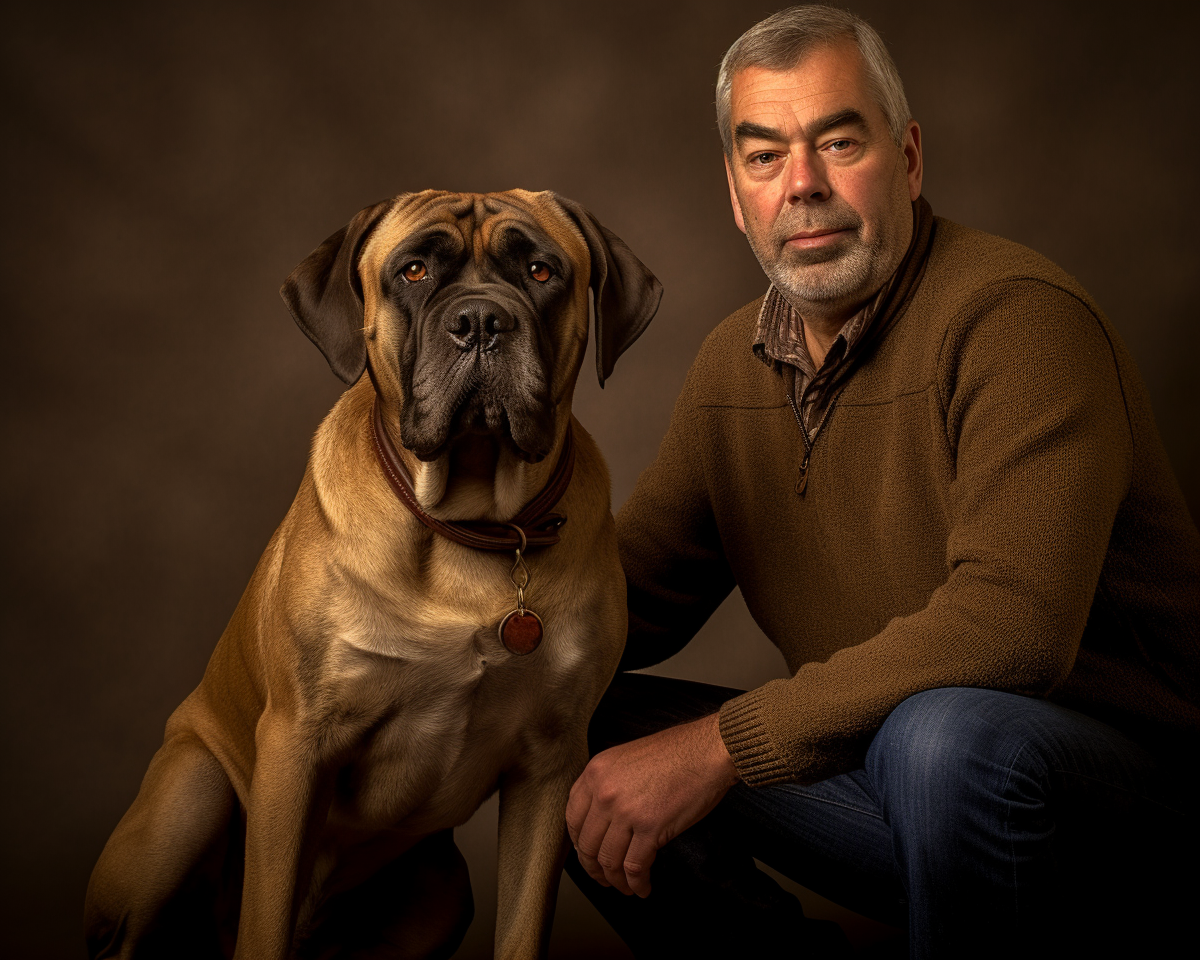
What similarities exist between human-AI look-alikes and human-other-living-being look-alikes, such as dog look-alikes?

Intriguingly, the parallels between human-AI look-alikes and human-dog look-alikes caught my attention. It's amusing to observe how both combinations exhibit resemblances that bring a smile to our faces. It's a testament to the creative interplay between humans, AI, and the natural world.

To add a touch of humor and entertainment, I've included some delightful dog-owner look-alike images in this post. These images were prompted and tweaked by yours truly, serving as a testament to the collaborative process between humans and AI.

As I reflect on this exhilarating journey, I can't help but feel a surge of excitement for what lies ahead. The realm of text-to-image AI is brimming with endless possibilities, and I eagerly anticipate the unexpected discoveries and remarkable creations that await us on this road.

So, my friends, join me as we venture further into the realm of AI-generated images. Let's celebrate the fusion of human ingenuity and AI's computational brilliance, uncovering the breathtaking artistry that emerges from this captivating collaboration. Together, we'll continue to explore and embrace the boundless horizons of AI's creative power.

It's going to be a wild ride, and I'm excited to share it with you in the upcoming chapters. May the Intelligence be with you.